Georgetown Elite Concrete pours concrete slabs in Georgetown, TX, with more than twenty years of slab work across Williamson County and jobs in surrounding cities including Serenada, Santa Rita Ranch, Round Rock, Brushy Creek and Jarrell. A slab looks like the simplest thing in concrete and is the one where everything that matters happens before the truck arrives, in the ground underneath and in the steel nobody sees again.
What a slab has to do here is carry a concentrated load on soil whose depth to rock changes across a single lot. SSURGO maps the west side of the city and Sun City in the Eckrant-Rock outcrop association, 58 percent Eckrant and 16 percent bare rock outcrop, with indurated limestone at a representative 28 to 30 centimeters, roughly 11 to 12 inches, while the southeast side in Castephen reaches weakly coherent bedrock nearer 41 centimeters, about 16 inches.
A slab that begins on rock and ends on fill is supported two different ways along its own length, and that is the condition most likely to crack it. We establish the profile under the whole footprint before designing the slab, then set thickness, reinforcement and jointing to suit what is actually there rather than to a standard section.
Slabs We Pour and What Each One Carries
Shed, Workshop and Outbuilding Slabs
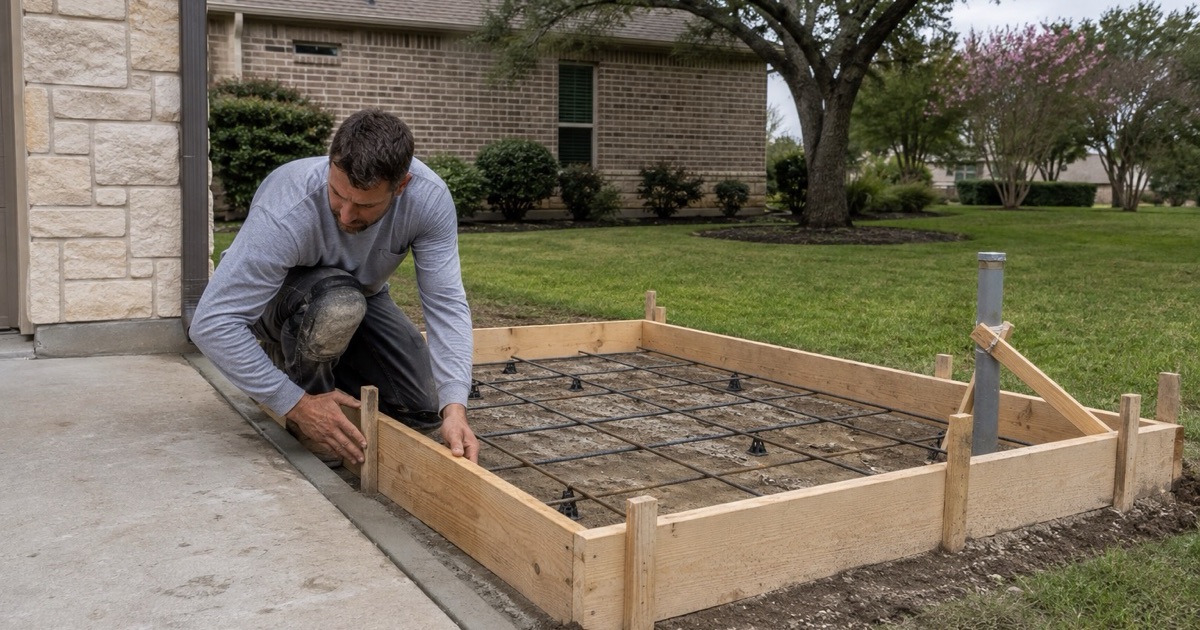
An outbuilding slab has to carry the structure at its perimeter and whatever ends up inside it, which is almost always heavier than the owner first describes. We thicken the edge where a wall bears, size the interior for the equipment that is genuinely going in, and set the slab high enough above surrounding grade that water runs away from the door rather than under it.
Equipment and Generator Pads
A generator, a mini split condenser, a water treatment unit or a compressor is a small footprint with a real point load, often with vibration and always with a service life that expects the pad to outlast it. We size and reinforce for the specific unit, set anchor positions from the manufacturer’s template before the pour rather than drilling afterwards, and detail the pad so water drains away from the equipment.
Hot Tub and Spa Pads
A filled spa is one of the heaviest things a residential property carries on a small area, and it usually arrives on a date fixed before anyone thought about the slab. We design for the filled weight rather than the shipping weight, and we coordinate the electrical so that NEC 680.26 equipotential bonding is placed in the slab where it belongs. Bonding is not something to retrofit under a full tub.
Garage and Interior Floor Slabs
An interior floor slab is a different specification because it is a moisture problem as much as a structural one. A vapor barrier under the slab, a subgrade that will not wick, and a finish appropriate to what goes on top all matter more indoors, and getting the vapor barrier detail wrong shows up later as a failed coating or a floor covering that will not stay stuck down.
What Goes In Before the Concrete
Subgrade Compaction and Base Course
Nearly every slab failure is a ground failure. We strip organics and soft material, compact the subgrade in controlled layers, and place a base course where the soil calls for one, giving particular attention to backfilled trenches, which settle long after everything around them has stopped. Concrete has no ability to span ground that was never prepared to carry it.
Vapor Barrier and Moisture Control
Under any slab that will be enclosed or take a floor covering, a vapor barrier lapped and sealed properly is the difference between a floor that works and one that quietly ruins whatever is applied to it. The detail that matters is continuity at laps, penetrations and edges. We install it as a system rather than as a sheet of plastic thrown in ahead of the pour.
Reinforcement, Chairs and Keeping Steel Where It Belongs
Reinforcement only does its job at the depth it was designed for, which means welded wire mesh or number four bar has to be on chairs and stay there while concrete is placed around it. Steel walked down to the bottom of a slab is decoration. Where the specification permits it, fibrous concrete distributes fine cracking through the section instead, and we say which one your slab is getting and why.
Thickness, Loads and Where the Joints Go
Thickness follows the heaviest load the slab will ever see, not the average one, and joints decide where the inevitable shrinkage relieves itself. We lay out control joints in proportioned panels and use dowel baskets where a slab has to transfer load across a joint without stepping. That combination is what keeps a slab flat rather than merely uncracked on the day it is finished.
Mix, Curing and Getting It Right
Specifying the Mix for the Job
Compressive strength, slump, air entrainment, water cement ratio and aggregate gradation are all decisions rather than defaults, and they move with what the slab does. Georgetown’s own flatwork specification gives a useful reference point at Class A concrete, 5.0 sacks of cement per cubic yard and a minimum 3,000 psi at 28 days, and structural work is often specified above that. The mix goes on the proposal.
Curing, and Why the Wait Is Not Padding
Concrete gains strength through a chemical reaction that needs water, so curing is an active process rather than drying out. A curing compound or wet curing over the first days does more for the finished slab than almost any other decision made on site. We give separate dates for foot traffic and for full loading, and we do not shorten them because a delivery is booked.
Finishing the Surface to Its Use
A broom finish for traction outdoors, a float finish where an open texture suits, a steel trowel finish for an interior floor that will take a coating: the finish is chosen from what the surface has to do, not from what looks best on the day of the pour. A hard-burnished exterior slab is a slip hazard, and an open-textured interior floor is difficult to coat.
- 20+ Years in Georgetown
- Permits Pulled & Inspections Booked
- Free Written Estimates