Georgetown Elite Concrete provides concrete leveling in Georgetown, TX, backed by more than twenty years of concrete work across Williamson County and serving surrounding cities including Serenada, Santa Rita Ranch, Round Rock, Brushy Creek and Jarrell. Leveling raises a slab that has sunk by filling the space that opened beneath it, which means the work is really about the void rather than about the concrete.
A slab settles because something under it left. On this ground the departures are specific: backfill over a utility trench that was never properly compacted, water finding a route along a footing or down an unprotected edge, and fill placed against shallow limestone that consolidates while the rock beside it does not move at all. The result is a slab supported firmly at one end and floating at the other.
That last case is common on the west side, where the Eckrant-Rock outcrop association runs 58 percent Eckrant and 16 percent bare rock outcrop and indurated limestone sits at a representative 11 to 12 inches. Any fill above that rock is the only compressible material present, so all the settlement happens in a thin layer. We find the void and its cause before we decide that lifting is even the right answer.
How Concrete Leveling Works
Polyurethane Foam Lifting
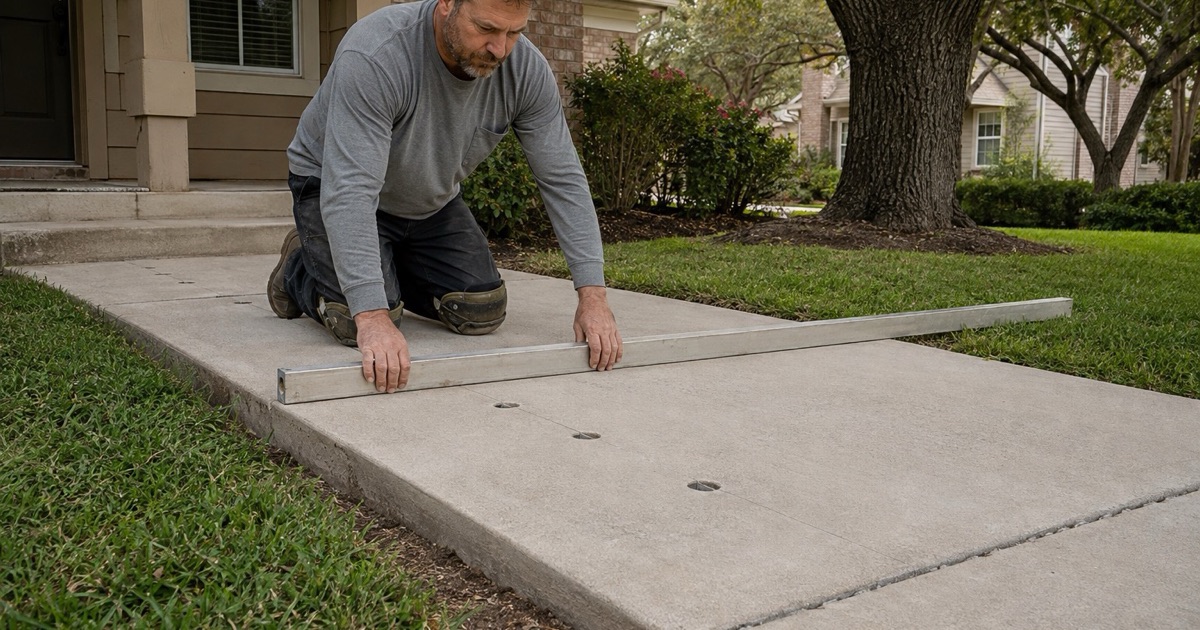
Foam lifting injects an expanding polymer through small ports drilled in the slab. The foam fills the void, then its expansion raises the concrete in controlled increments while we watch the surface come back to grade. It is light, it does not add meaningful load to ground that has already proved it cannot carry weight, and it reaches full strength quickly enough that the slab is usually back in service the same day.
Mudjacking and Slurry Lifting
Mudjacking pumps a cementitious slurry through larger holes to do the same job. It costs less per unit and suits large, thick slabs and heavier applications well, but the material is considerably heavier than foam and the access holes are bigger. On soils that settled because they could not carry load in the first place, adding weight is a real consideration, so we choose between the two on the site rather than on preference.
Drilling, Injecting and Patching
Either method leaves a pattern of ports through the slab, spaced to reach the whole void rather than placed where they are convenient. We lay the pattern out from where the slab has dropped and where we expect the void to run, lift in stages while measuring, then fill and finish the ports. They remain visible on close inspection, and we say so before starting rather than after.
Getting the Grade Right Rather Than Level
The goal is almost never dead level. A driveway, patio or walk needs fall to move water away from a building, so the target is the grade the slab should have had, not a flat plane. Lifting a panel to level can send water at a foundation that was previously draining fine. We set the target grade with the drainage in mind and lift to that.
When Lifting Is Right, and When It Is Not
The Slabs Worth Lifting
Lifting is the right answer when the concrete itself is sound and has simply gone down: a slab in reasonably whole panels, with intact edges, cracked at the joints rather than throughout. In that case you are buying back the geometry of a serviceable slab for a fraction of the cost and disruption of demolition, and you keep the surface you already have.
The Slabs That Are Past It
A slab spidered with cracks through its depth, missing its edges, badly spalled, or broken into pieces small enough to move independently will not come up as one surface. You can lift it, and you will then own a raised version of a slab you were always going to replace. We say that plainly at survey, because the cheapest visit is the one that talks you out of the wrong repair.
Fixing the Void Without Fixing the Cause
Filling a void solves today’s symptom. If water is still tracking down the same route, the fill will consolidate or wash and the slab will drop again, usually within a couple of seasons. We look for the source first, whether that is a downspout discharging at a slab edge, a leaking service, an unprotected edge or a trench that keeps giving, and we tell you what has to change alongside the lift.
Interior Floors and Self Leveling Underlayment
Inside a building the problem is usually a floor that is out of plane rather than a slab that has dropped, and the answer is different: a self leveling underlayment poured over a prepared surface to give a flat plane for tile, vinyl or a finished coating. It is a resurfacing operation, not a lifting one. We keep the two clearly separated, because they solve different problems and cost very different amounts.
The Places Slabs Sink Around a Property
Driveways and Approaches at the Street
Driveways sink at the joints and at the approach, where trench backfill from utility work and the transition into the public right of way meet vehicle loads. A lifted panel at the approach also has to end up matching the street rather than simply being higher than it was, which is a grade problem more than a lifting one.
Garage Slabs and the Line at the Door
A garage floor that has dropped shows itself at the door line, where a step appears between the apron and the slab and water starts running the wrong way. Lifting the apron back to the door is one of the most common jobs we do, and the measurement that matters is the fall away from the threshold rather than the amount of rise achieved.
Patios, Walks and Pool Decks
Around a patio or a pool deck a settled panel is a trip hazard first and a drainage problem second, and both of them get worse each season. Pool decks in particular tend to settle where backfill was placed against the shell. Lifting restores the fall away from the water and closes the lip that people catch, without disturbing the coping or the surrounding finish.
Public Walks and Commercial Flatwork
On commercial property a settled panel with a lip on an accessible route is a compliance and liability question, since changes in level are measured against the Texas Accessibility Standards rather than judged by eye. Lifting the panel is frequently faster and far less disruptive to a trading site than removing and replacing it, and it leaves the surrounding surface untouched.
What We Check Before Quoting a Lift
Shooting the Elevations Across the Slab
We take levels across the whole slab rather than at the obvious low corner, because the shape of the settlement tells you where the void runs and how the panel is bearing. A slab that has tipped as a plane is a different problem from one that has dished in the middle, and the injection pattern that fixes one will not fix the other. That survey is also the record we lift against.
Sounding for the Void and Probing the Depth
Tapping a slab tells you where it has lost contact with the ground beneath it, and probing at the edges tells you how deep the compressible material goes before something solid stops it. On the west side that solid layer is frequently indurated limestone within the first foot, which means the void, the fill and the whole settlement story sit in a very thin band.
Tracing Where the Water Is Going
Almost every void was cut by water, so we follow the route: downspouts discharging at a slab edge, irrigation running against an approach, a service leak, a grade that falls toward the house rather than away from it, or an unprotected edge losing material every time it rains. If that route is still open after the lift, the void will reopen, and the quote says what needs changing.
What the Slab Has to Carry
A patio panel and a driveway a loaded truck reverses onto are the same operation with different requirements underneath. We ask what actually uses the surface, including deliveries and trailers people forget to mention, and choose between foam and slurry on that basis as much as on cost, since the heavier material is a real consideration on ground that has already demonstrated it struggles to carry load.
- 20+ Years in Georgetown
- Permits Pulled & Inspections Booked
- Free Written Estimates