
Georgetown Elite Concrete pours concrete driveways in Georgetown, TX, with more than twenty years of driveways behind us across Williamson County and work in surrounding cities including Serenada, Santa Rita Ranch, Round Rock, Brushy Creek and Jarrell. A driveway is the largest single piece of concrete most properties will ever buy, and it is also the piece the city takes the closest interest in.
That interest is not theoretical. A city driveway permit is required any time work adds to an existing driveway or changes or alters the approach, the approach being the portion of the driveway at the street that crosses the utility easement, usually the first 10 feet. The submittal is one merged PDF holding a plot plan showing all structures, building lines, public utility easements and drainage easements, a marked indication of the proposed change, and a drawing or detail of the steel reinforcement.
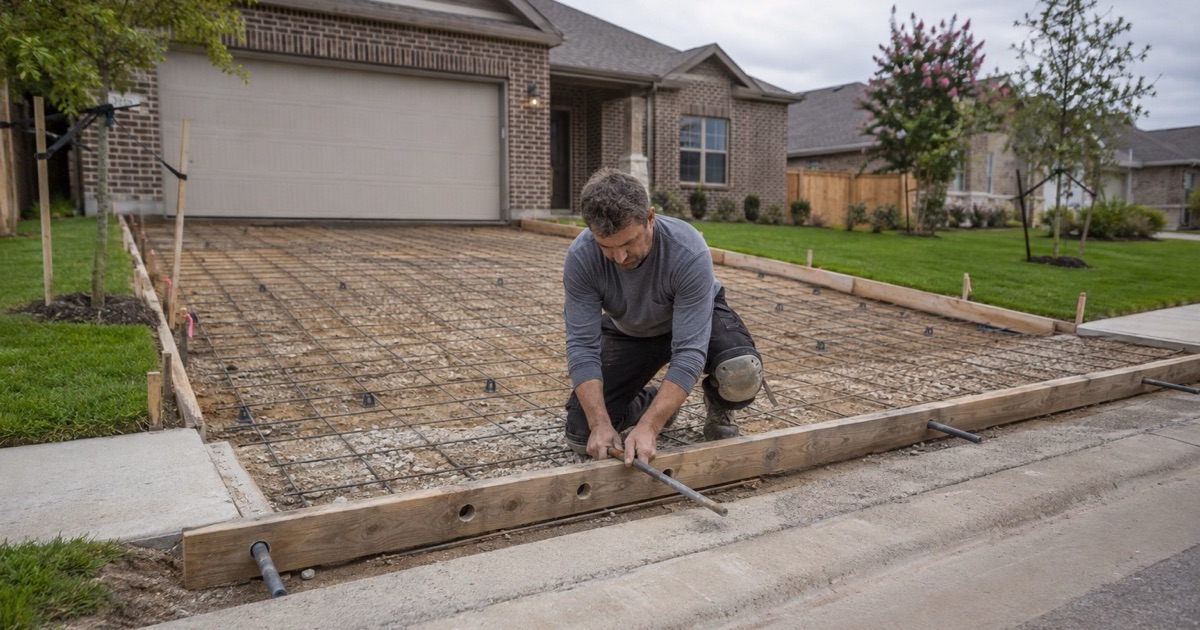
Review runs 10 to 15 business days, and both a pre-pour inspection before concrete is placed and a final inspection are required. We assemble that package and book both inspections as part of the job, because a driveway poured ahead of its pre-pour inspection is a driveway somebody may have to open up again.
Designing the Drive Before Anyone Pours It
Width, Radius and the Standard Detail It Answers To
Georgetown has adopted SD-15 at a ten foot minimum width, a four foot six inch radius and six inches of thickness, and SD-16 at twelve feet, five feet and five inches. Both are adopted, and which one governs depends on the job. We name the sheet on the quote so the finished drive can be checked against the document rather than against an impression of what was agreed.
Thickness and What the Drive Actually Carries
A driveway used by two cars is a different structural problem from one a loaded truck, a trailer or a motorhome reverses onto, and thickness is the cheapest place to solve that difference. We size the slab to the heaviest vehicle that will genuinely use it, including the delivery and service traffic owners rarely think to mention, rather than defaulting to a residential section and hoping.
Jointing, Panel Layout and Where It Will Crack
Concrete cracks; jointing decides where. We lay out control joints and sawcut joints in panels proportioned so the slab relieves its shrinkage along a line we chose, and we put expansion joints where the drive meets a garage slab, a walk or a fixed structure. A drive with no joint plan does not avoid cracking, it simply cracks somewhere nobody picked.
Drainage and Where the Water Ends Up
A driveway is a large impervious surface, so it changes where water goes on the whole lot. We set the falls to move water away from the house and toward somewhere it can actually be received, rather than solving one puddle by delivering it to a neighbor or a foundation. This is also where added impervious cover gets checked against what the lot is allowed.
Subgrade, Reinforcement and Mix
Subgrade Compaction and Base Course
Almost everything that goes wrong with a driveway happens below the concrete. We strip the organics, correct soft spots, compact the subgrade and place a base course where the ground calls for one, and we pay particular attention to backfilled trenches, which are the single most reliable place for a drive to settle later. Concrete cannot bridge ground that was never prepared.
Mesh, Bar or Fiber, and the Document That Decides
SD-15 mandates six by six number six mesh, or number four bar at sixteen inches on chairs, while SD-14 and specification C5.04(G) permit fibrous concrete instead. The city’s flatwork specification allows fibrous concrete using 100 percent virgin polypropylene fibrillated fibers meeting ASTM C-1116 at no less than 1.5 pounds per cubic yard. We use what the governing document allows for your job and we say which document that is.
The Mix on the Ticket
Public flatwork here is specified as Class A concrete: 5.0 sacks of cement per cubic yard, a minimum 3,000 psi compressive strength at 28 days, and a maximum water-cement ratio of 6.5 gallons per sack. Private work is specified to what it carries, which often means a higher compressive strength. We put slump, strength and aggregate gradation on the proposal so the ready mix ticket can be checked on the day.
Rock, and What the Excavation Really Costs
Depth to refusal changes across Georgetown rather than holding constant, so the same drive costs different money on different sides of town. We establish what the ground gives before quoting, and where the excavation genuinely carries risk we show the rate instead of hiding it in the square foot price. That is also why we tell you the size of job a square foot figure was worked out from.
Finishes, Approach and Local Rules
Broom Finish and the Alternatives
A broom finish is the default on a driveway for good reason: it gives traction wet, it wears well and it hides the ordinary marks of use. Where an owner wants more, exposed aggregate, a color hardener, a border or a stencil coating all work on a drive. We match the finish to a surface people walk on in the rain, not only to what photographs well.
The Approach, the Apron and the Right of Way
The strip where your drive meets the street belongs to a different set of rules from the rest of it, and the city calls it an approach on one document and an apron on another. It has its own detail, its own inspection and its own permit trigger. We treat it as its own element of the job so that the part the city will actually look at is built to the sheet that governs it.
Ribbon Paving and What Counts as a Surface
Georgetown’s historic district guidelines recommend ribbon paving, and city code section 10.16.010 counts two parallel eighteen inch strips as an approved surface, while the development code’s paved surface definition excludes them. Those documents answer different questions. We work out which one your lot is judged against before designing a ribbon drive, because the answer decides whether it is elegant or non-compliant.
Driveways Inside Sun City
Sun City’s driveway rules are dimensional and enforced. A widened driveway must replicate developer-installed driveways, added areas beside the driveway may not extend more than 2 feet on either side, and driveway width at the curb may not exceed 30 feet. On the Monterey and Newport cottage models the work is shared: adjoining driveways must be coated at the same time, in the same approved color and texture, by the same contractor.
Timing, Access and Living With the Job
Impervious Cover and How Much Drive You Are Allowed
Under the UDC adopted August 11, 2026, residential impervious cover is capped at 60 percent for front-access lots and 70 percent for alley-access lots in the Residential Suburban and Residential Mix districts, and 40 percent in Residential Estate and Residential Transition. A wider drive is not only a construction question, it is an allowance question. We run the numbers before you commit to a size.
Working in the Right of Way
Right of way work on Georgetown arterials runs half past eight to half past three with no weekends, which is a seven hour working window. That constraint shapes how an approach gets sequenced and how long the street-side element takes. We plan the job around it from the start rather than discovering it on the first morning with a truck already booked.
Pouring Through a Drought Restriction
Concrete and asphalt work is exempt by name through emergency drought stage four under section 13.16.090(A)(5), even while stage three bans washing driveways, parking lots and patios. Owners regularly postpone a drive through a dry summer assuming the city will not permit it. It will, and we would rather tell you that than let a project sit for a season on a misunderstanding.
Losing the Drive, and Getting It Back
The honest part of a driveway quote is the days you have nowhere to park. We give you a date the old surface comes out, a date the pour happens, and separate dates for foot traffic and for vehicles, because curing rather than placing decides the last of those. Where a household genuinely cannot lose access we sequence the drive in halves and say what that costs.
- 20+ Years in Georgetown
- Permits Pulled & Inspections Booked
- Free Written Estimates